
Privacy-firsttabletopdiscovery,explained
How DiceGather finds you nearby games without tracking your location — what we store, what we never store, and why coarse-only is a product choice.
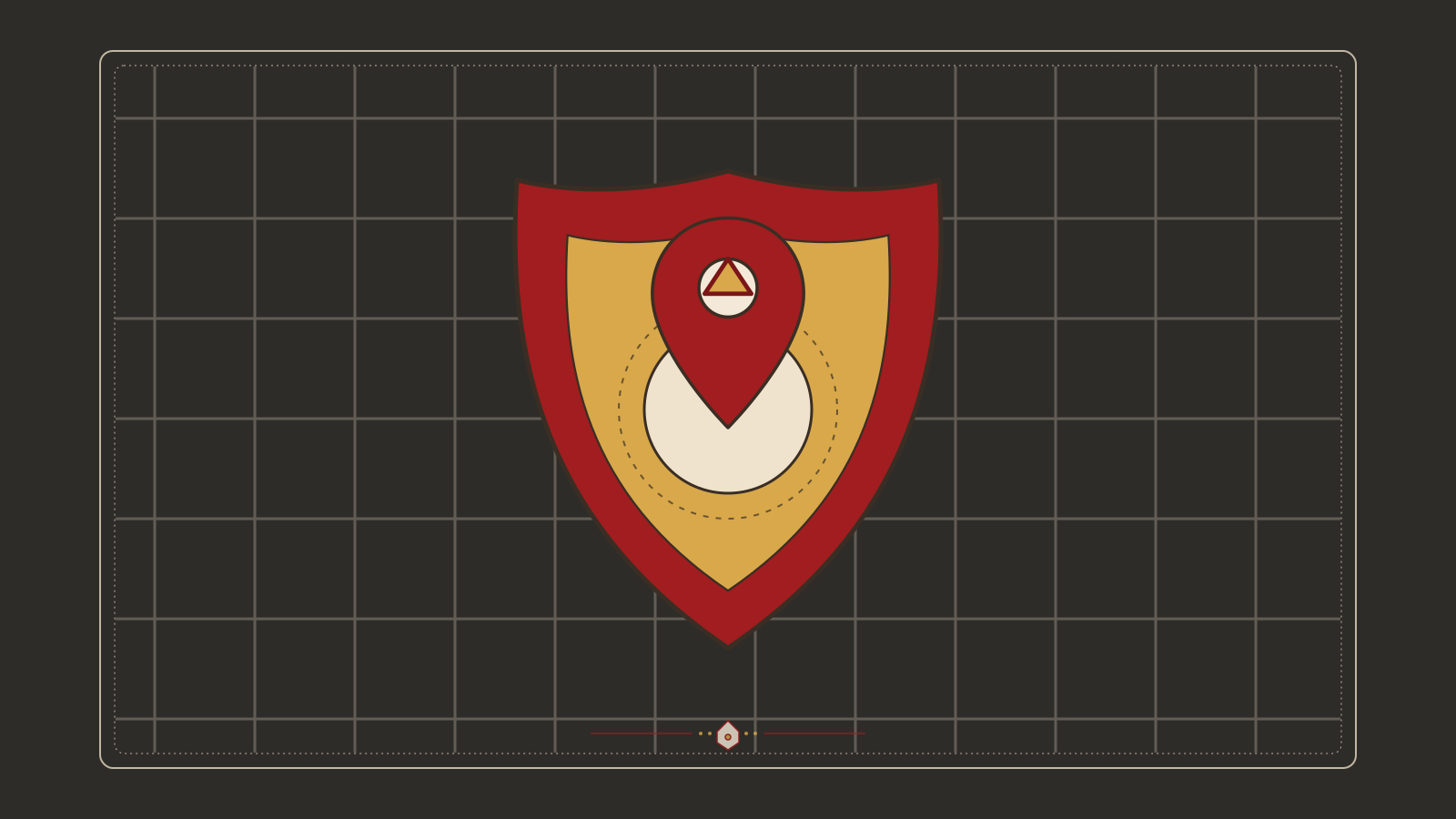
Most meetup apps treat privacy as a legal chore. They want your precise location because it's easier, and they add a privacy policy to cover it.
DiceGather treats privacy as a product feature. We don't store your precise location, because we don't need it, and because the product is better without it. This is a practical tour of how that works, what we store, what we never store, and the honest tradeoffs. For the short version, our features page shows what the app does without the tracking other apps assume.
What most apps do
The default for a location-based app is roughly:
- Ask for background location permission on install.
- Collect GPS coordinates periodically (every few minutes, sometimes continuously).
- Store those coordinates tied to your user ID.
- Use them to show who is "near" you in real time.
That architecture leaks data. The GPS fingerprint of someone's movement over weeks is deeply personal — home address, workplace, favorite bar, therapist's office. Even if the app is well-intentioned, a breach or a data-sharing agreement can expose all of it.
It's also usually overkill. Meetup apps for hobbies don't need minute-by-minute location. They need enough to show relevant nearby things.
What DiceGather does instead
DiceGather uses coarse, city-level location. When you onboard, you pick a general area from a city search — something like "Berlin" or "Greater Seattle" — and that's what we store on your profile. Not a GPS fix. Not even a neighborhood. A city.
The details:
- We store your chosen city as a name plus a small pair of approximate coordinates (the city center).
- We never store your device's GPS position, and we never ask for background location permission.
- Location access is optional. If you allow it, your position is used in the moment — to center the map on you, or to center the nearby-players search — and then it's gone. It is never saved to your profile and never shown to anyone else. If you say no, everything works from your city.
- Meetup intents you create have their own location — a point you pick on the map for the meetup itself — which is separate from your personal profile.
- The Nearby Users feature places every other player at the center of their city, never at their device. Nobody's real position is ever revealed to another user, and no distance to an individual player is shown.
You can travel. You can change cities. You can pick a coarse location you feel comfortable with (maybe not the exact town where you live, but the nearest larger one). The system is designed to work with roughness.
What ends up on the map
Two categories of markers:
- Meetup intents. Someone has said "I want to play X at time Y around this spot." The marker is where the meetup is, not where the host lives. Gold for your own, green for joined, neutral for others.
- Nothing else. No user dots. No "people near you" pins. No passive presence markers.
If you zoom into an empty part of the map, it looks empty. That's not a design flaw — that's accurate. Nobody has posted an intent there yet. The map is a feed of willingness, not a list of people.
Bridging the "empty map" problem without tracking
A map that's empty at 9am on a Tuesday is honest but not immediately useful. You want to know: are there even any tabletop players in my area?
The answer is the Nearby Users feature: a count of players inside your coarse radius, sorted so anyone with an active meetup floats to the top. Every player in that count is placed at the center of the city they picked, never at their device. The search starts from your city — or from where you are, if you've allowed location access — and that starting point is used for the search and not kept. We don't show distances to individual players. We don't expose who has opened the app recently or what they did.
It's social proof without surveillance. You learn "yes, there are 27 players in your area, and 4 of them have posted meetups." That's enough to make you want to post one yourself, which is the whole point.
The tradeoffs, honestly
Privacy-first design costs us some things:
- No live "who opened the app right now" signal. You'll see who posted an intent, not who's scrolling.
- Nearby radii are approximate. If you live exactly on the border between two cities, you may need to pick the city that matches your activities, not your address.
- You have to post to be seen. DiceGather doesn't enroll you into a passive "discoverable" state. You have to create an intent for strangers to notice you, or keep your profile public so it appears in search.
We think those costs are fine. The upside is a product you can use without installing surveillance on your own phone, and without contributing to a system that aggregates everyone's movement.
What about the data we do store?
The shortlist:
- Your email (for account recovery) and the auth tokens that keep you signed in.
- Your display name, @userId, avatar, about text, interests, and any gallery images you choose to upload.
- The city you picked.
- The meetup intents you created (game, time, map pin, note).
- Messages you send in group chats and DMs.
We do not:
- Store device GPS coordinates.
- Track your movement, historically or in real time.
- Sell data to ad brokers or anyone else.
- Use cross-app advertising identifiers.
- Install third-party trackers on the web or in the app.
The full list is on the Privacy page, which we keep in plain English because policy pages written by lawyers are the opposite of trust-building.
Why this is a better product, not a slower one
A common worry with privacy-first design is that it slows things down. It can, for some apps. For a tabletop-meetup app, it doesn't.
Tabletop hobbies run on a weekly-ish rhythm. You plan a few days ahead. You show up. You play. Nothing about that process benefits from real-time tracking. The signal that matters — "I want to play X on Saturday" — is explicitly stated, not inferred from where your phone is.
Building around explicit signals instead of inferred ones means the whole product is cleaner. You can reason about what the app knows about you, because it's exactly what you typed into it.
Try it without giving up your location
DiceGather works on a coarse city you pick, not a GPS fix we keep. Location access is optional: the app may ask so it can center the map on you, and if you say no, everything still works from the city you picked during setup.
Get the app on iOS or Android. See the full privacy principles for a plain-English tour.
Yes, let's play.
DiceGather is free on iOS and Android. Post your first meetup intent in under a minute.


Frequently asked
Tags
Published by DiceGather Team on · Updated .
Yes, let's play.
DiceGather is free on iOS and Android. Post your first meetup intent in under a minute.
More from the journal
Browse all →
Why we built DiceGather intent-first, not location-first
Why DiceGather is intent-first, not location-first. A short essay on willingness vs presence, and why a tabletop rhythm makes for a better meetup app.
Is there an app to find people to play board games with?
Yes, several. An honest look at the apps and sites people use to find board game and D&D players nearby, what each is good at, and where DiceGather fits.
How to find board game players after moving to a new city
A two-week plan for finding board game players in a new city: where the scene hides, how to show up alone, and when to start hosting your own night.