
Howtofindboardgameplayersaftermovingtoanewcity
A two-week plan for finding board game players in a new city: where the scene hides, how to show up alone, and when to start hosting your own night.
The shelf arrived before the friends did. Your old Thursday group is now a time zone away, the boxes are unpacked, and Wingspan is sitting on a bookcase in a flat where nobody else knows the rules. Moving is one of the most common reasons people go from "plays every week" to "hasn't played in a year", and it happens quietly.
This is a plan for finding board game players in a new city that doesn't rely on luck: what to do in the first two weeks, which channels actually turn into a table, and the point at which you stop looking for a group and start being one.
TL;DR: Spend week one mapping who already plays. Spend week two showing up to two things alone. Then post what you want to play, host once in a public place, and keep the same night for two months.
Week one: find out who is already playing
Every city of any size has a board game scene. The problem is that it doesn't advertise. Spend the first week building a short list:
- Game stores. Search "board game store" and "game shop" plus your city. Open each store's site or Instagram and look for an events calendar. Many run at least one open play night.
- Board game cafés. If your city has one, it's the easiest place to sit down with strangers. More on that in our guide to playing board games with strangers.
- Library calendars. Search your library system for "board games". These are free and beginner-friendly, and they exist in far more towns than people assume.
- BoardGameGeek guilds. BoardGameGeek has regional guilds, member-run groups for a city or country, and their forums are where the long-running local meetups often announce themselves.
- Facebook groups and Discord servers. Search your city plus "board games". The quality varies wildly, but somebody in the group knows where the good Tuesday night is.
- Meetup.com. Still useful for established groups with a fixed venue. Check when the last event actually happened before you get excited about the member count. We compared it with the other options in Meetup.com alternatives for tabletop.
You aren't trying to attend anything yet. You're trying to end the week with three specific things on a calendar.
Week two: show up to two things, alone
This is the part people skip. Going to an open game night alone feels awkward for roughly the first eight minutes, and then someone asks whether you know Cascadia.
Some ways to make the first visit easier:
- Arrive at the start, not an hour in. Tables form early, and hosts seat solo players first.
- Bring one game that seats five and teaches in ten minutes. Azul, Ticket to Ride, Cascadia, The Crew, Codenames, Just One. Being the person with a good game is a social skill you can buy.
- Say the sentence. "I just moved here, I'm looking for people to play with." It is disarming, it is true, and it gets you invited to the thing that isn't on any calendar.
- Ask the host what else exists. Every open night host knows about two other groups.
Go to two different things in week two. One will be wrong for you. That's fine; the second one usually isn't.
Post what you want to play instead of only browsing
Browsing calendars finds the groups that already exist. It doesn't find the four other people who moved to your city this year and are doing the same thing you are.
That is the gap DiceGather is built for. You post a meetup intent — the game, a rough time, a spot on the map, a short note — and anyone nearby who wants the same thing can join and start chatting. See how meetup intents work. A note like "New in town, looking for a regular mid-weight euro group, happy to teach" is exactly the kind of post that finds its people.
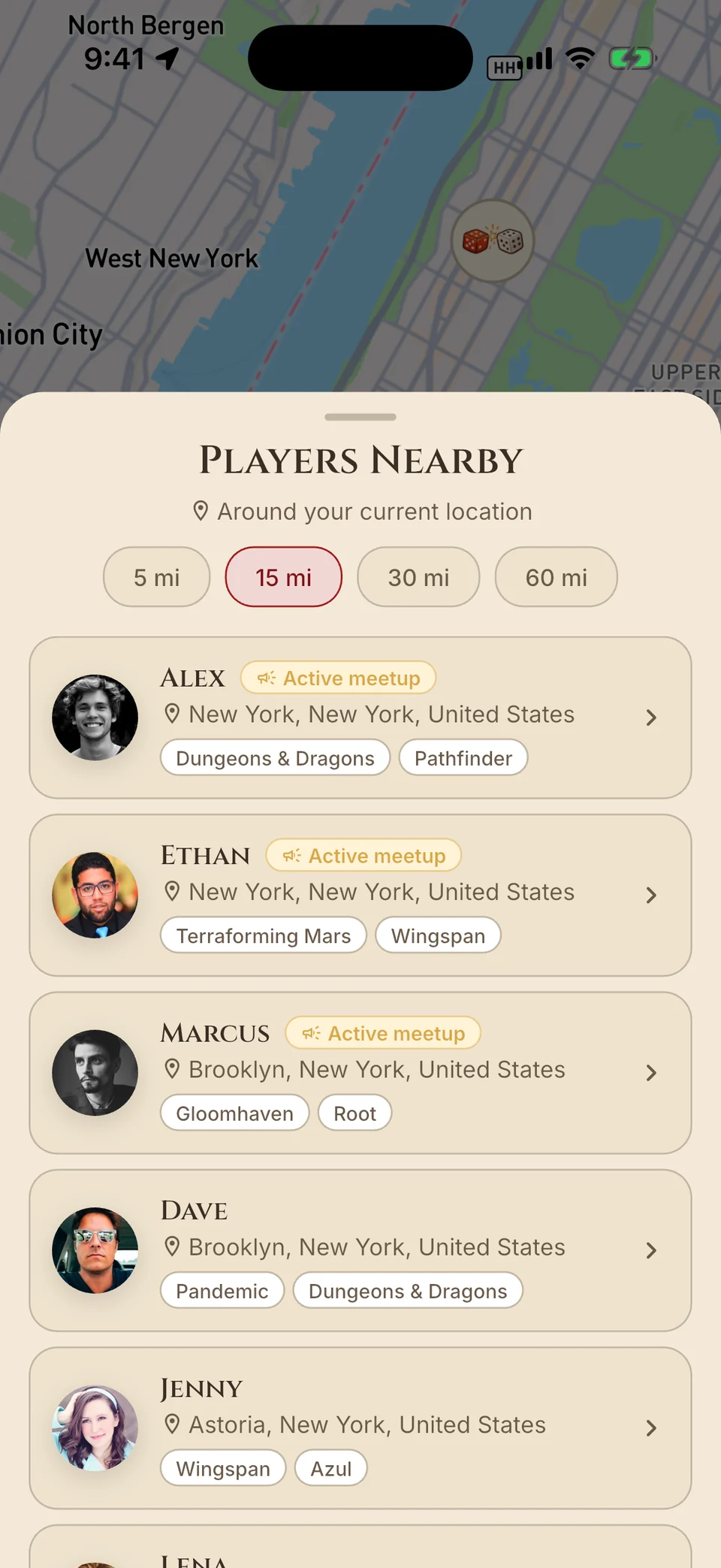
The thing that helps most right after a move, though, is knowing you aren't shouting into a void. The Nearby Players count shows how many tabletop players are in your area, with anyone hosting an active meetup at the top. It's based on the city you picked, not GPS, so nobody's location is exposed, including yours. A quiet map with a healthy player count means the players exist and nobody has posted yet. You can be the one who does.
Host once, in a place you don't own
At some point, usually around week three or four, the fastest way to get a regular group is to run one. You don't need a big flat or a great collection.
- Pick a public venue. A café with big tables, a pub back room on a slow night, a library meeting room. Ask the staff; most say yes to a quiet group that buys drinks.
- Bring two games, not ten. One that seats five and one backup.
- Cap it. Four to five people including you. Bigger groups split into tables and need a second host.
- Fix the end time. "Seven to ten" gets a yes from people who can't commit to an open-ended evening.
- Post it everywhere you found in week one, plus as an intent. Cross-posting isn't spam when it's one specific event.
If two people turn up, that's a game night. If nobody does, you had a coffee and you post the same night again next week.
The two-month rule
New groups fail because they move around. Same night, same place, same time for eight weeks, and people who couldn't make the first three will make the fourth. Attendance in week one tells you almost nothing.
Keep a small group chat for the regulars, but keep posting the night publicly too. A group that only recruits from its own chat stops growing the week the founder gets busy.
Keep the old group while you build the new one
None of this means letting go of the people you moved away from. Online play is good now: a video call and something like Board Game Arena will keep your old Thursday alive across whatever time zone gap you've got. The new local group is in addition, not instead. Most people who make the move well end up with both.
Find your new table
Finding board game players in a new city is mostly showing up twice, saying one honest sentence, and then posting what you want to play instead of hoping someone else does. See who's nearby, post your first intent, and get the first game on the calendar this week.
Yes, let's play.
DiceGather is free on iOS and Android. Post your first meetup intent in under a minute.


Frequently asked
Tags
Published by DiceGather Team on .
Yes, let's play.
DiceGather is free on iOS and Android. Post your first meetup intent in under a minute.
More from the journal
Browse all →
Is there an app to find people to play board games with?
Yes, several. An honest look at the apps and sites people use to find board game and D&D players nearby, what each is good at, and where DiceGather fits.
How to find a D&D group as an adult beginner
How to find a D&D group as an adult beginner: where new players are welcome, what to say when you reach out, and how to skip the intimidating parts.
Meetup.com alternatives for tabletop and board game groups
Looking for a Meetup.com alternative for board games or D&D? What Meetup still does well, where it falls down for small tables, and what to try instead.