
Meetup.comalternativesfortabletopandboardgamegroups
Looking for a Meetup.com alternative for board games or D&D? What Meetup still does well, where it falls down for small tables, and what to try instead.
The group has eight hundred members. Six people came to the last event, two of them for the first time, and the organizer is paying a subscription for the privilege of chasing RSVPs. If you've run or joined a tabletop group on Meetup.com, you've probably seen some version of this, and at some point you've searched for a Meetup.com alternative for board games or D&D.
This is that search, answered honestly. Meetup is still good at some things. It's structurally wrong for others, and the "others" happen to include the most common thing a tabletop player wants: a specific game, at a specific time, with three or four people. Here's what it does well, where it breaks, and what to use instead.
TL;DR: Keep Meetup for big, recurring, venue-based events. For everything smaller, use a store or café calendar for existing groups, a Discord or Facebook group for the chatter, and an intent-based app like DiceGather for "who wants to play this on Saturday".
What Meetup.com is still good for
Credit where it's due:
- Discoverability of established groups. Search a city and you'll find the long-running weekly board game night, with photos, past events, and a venue.
- Recurring events with a calendar. RSVP lists, reminders, a page you can send to a friend.
- Big open nights. Twenty people at a café on a Tuesday is exactly what the format is for.
If the group you want already exists there and actually meets, join it. Nothing below is a reason to leave a group that works.
Where Meetup falls down for tabletop
The problems are structural, not fixable with a better organizer.
- It's event-shaped, not intent-shaped. Meetup answers "what's happening?", not "who wants to play Gloomhaven on Sunday?" Someone has to create an event before anyone can say yes to it, and most small games never get an event page.
- The organizer pays. Groups depend on one person's subscription and energy. When that person moves or burns out, the group with eight hundred members goes dark.
- RSVPs are not attendance. Large groups grow a layer of people who joined years ago, RSVP out of habit, and never show. The count on the page tells you little about who'll be at the table.
- Wrong scale. A game night is four to five people. A Meetup group is built to be fifty. Splitting a big turnout into tables is work the organizer does by hand every time.
- Cold for newcomers. Walking into a twenty-person event alone is harder than joining a four-person game where you've already been chatting for a week.
None of that is a scandal. It's a tool designed for a different shape of gathering than a table of four.
The alternatives, by what you actually need
The right Meetup.com alternative depends on which of three things you're missing.
You want an existing weekly group
- Game store calendars. Many stores run open play, D&D nights, and learn-to-play events. The store's site or Instagram is the calendar.
- Board game cafés. Reservable tables and open nights, and staff who will seat you with strangers. See where to play board games with strangers.
- Libraries and community centers. Free, mixed-age, often less intimidating than a store.
- Adventurers League. For D&D specifically, official organized play at stores is the most reliable drop-in there is.
You want the local chatter
- City Discord servers. Where regulars talk. Good once you're in, invisible before that.
- Facebook groups. Still the default in a lot of cities for trades and big nights.
- BoardGameGeek guilds. Regional guilds for the serious end of the hobby.
You want a specific game, at a specific time, with a few people
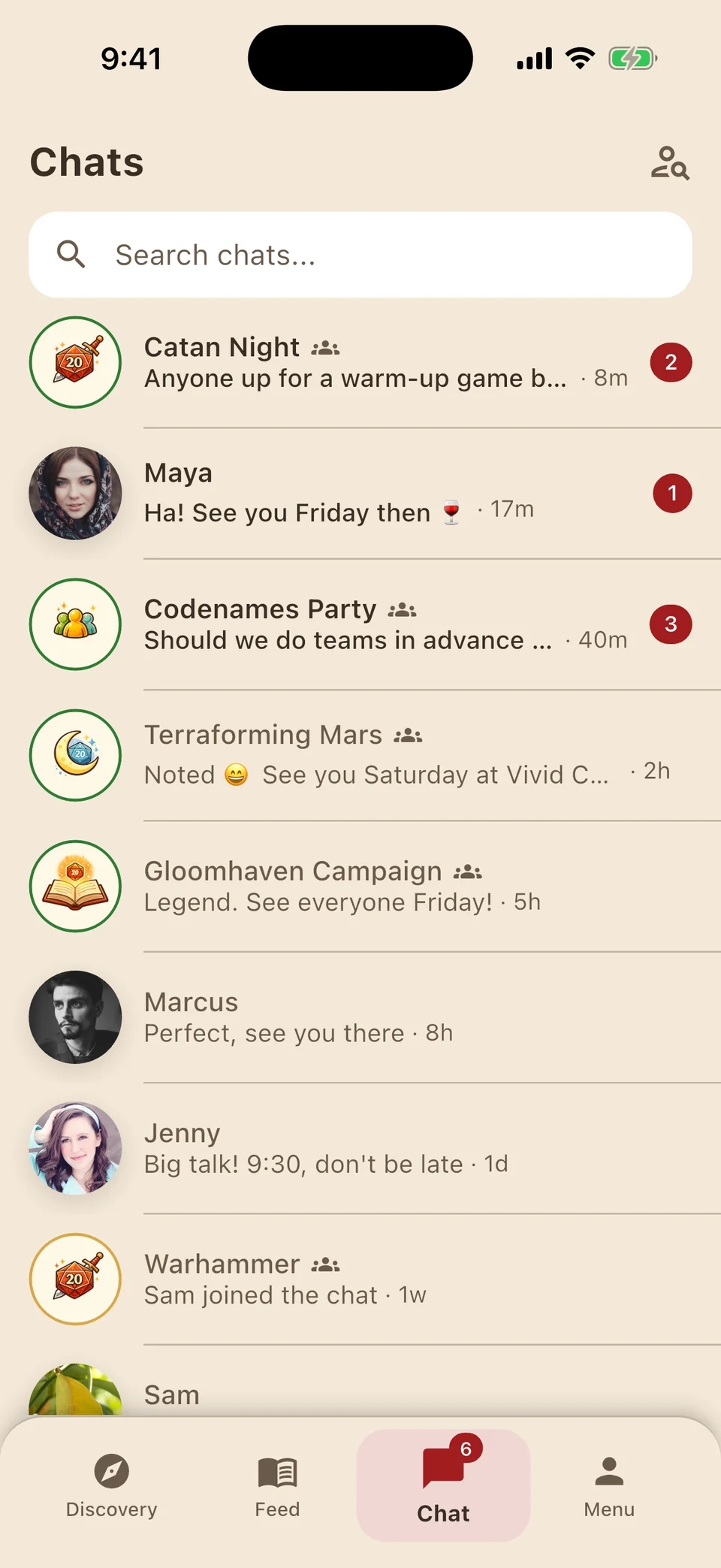
This is the one Meetup can't do, and it's what we built DiceGather for. You post a meetup intent — the game, a rough time, a pin on the map, a short note — and people nearby who want the same thing join. There's no event page to build, no organizer fee, and no membership count to pad; the only thing on the map is meetups people have actually posted. The moment someone joins, a group chat opens, so the "where exactly and what time" conversation happens in one place. See how intents work, and note that the app works from the city you pick, not GPS, so nobody's location is on the map.
For D&D-only searches, r/lfg and D&D Beyond's group finder cover the same ground with a wider net and less geography. We compared all of these in is there an app to find people to play board games with.
You want a big one-off event
Eventbrite, the store's own ticketing, or a convention. Meetup is fine here too.
Moving a group off Meetup without losing people
If you run a group and you're done paying, the move is straightforward if you do it in this order:
- Announce it on Meetup first, with dates, and leave the group up for a month. People need to see the sign more than once.
- Pick one place for chat and one place for events. A Discord for the regulars, plus a public event source, whether that's the store calendar or intents on DiceGather. Don't scatter across five.
- Keep the same night and venue. The night is the group. Change the tool, not the night.
- Post every session publicly, not just in the chat. A group that only talks to itself stops growing the month you get busy.
- Ask the regulars to bring one person to the first post-Meetup night. It resets the "is this still alive?" question.
Pick the tool for the table size
Meetup.com is a good tool for big, recurring events and a poor one for a table of four. Use it for what it's for, and for the specific-game-on-Saturday problem, post the game you want and let the people nearby find you.
Yes, let's play.
DiceGather is free on iOS and Android. Post your first meetup intent in under a minute.


Frequently asked
Tags
Published by DiceGather Team on .
Yes, let's play.
DiceGather is free on iOS and Android. Post your first meetup intent in under a minute.
More from the journal
Browse all →
Is there an app to find people to play board games with?
Yes, several. An honest look at the apps and sites people use to find board game and D&D players nearby, what each is good at, and where DiceGather fits.
How to find board game players after moving to a new city
A two-week plan for finding board game players in a new city: where the scene hides, how to show up alone, and when to start hosting your own night.
How to find a D&D group as an adult beginner
How to find a D&D group as an adult beginner: where new players are welcome, what to say when you reach out, and how to skip the intimidating parts.