
HowtofindaD&Dgroupasanadultbeginner
How to find a D&D group as an adult beginner: where new players are welcome, what to say when you reach out, and how to skip the intimidating parts.
You bought the dice before you had anyone to roll them with. Maybe a coworker mentioned their Tuesday campaign, maybe you fell down a hole of actual-play videos, maybe you played once in a school library twenty years ago and never again. Either way you're an adult who wants to find a Dungeons & Dragons group, you have never really played, and every door you can see seems to have a "regulars only" sign on it.
That sign is mostly in your head. This is a guide to finding a D&D group as an adult beginner — where new players are actually welcome, what to write when you reach out, and how to get a first session on the calendar without walking into a room of strangers cold.
TL;DR: Look for beginner nights at game stores and libraries, ask for a one-shot rather than a campaign, be honest about being new in the first sentence, and post what you want instead of only browsing. Most tables like teaching.
You are not too late, and you are not the odd one out
Plenty of players sit down for their first game of D&D in their thirties, forties, or later. A table is a mix of people who have played for twenty years and people who learned the word "initiative" last week, and the game handles that mix fine because every player only needs to know their own character.
Dungeon Masters, the people who run the game, tend to like beginners. New players have no habits to unlearn, they react to the story the way the DM hoped somebody would, and they ask the questions everyone else forgot were interesting. The thing DMs actually dread is a flaky player, not a green one.
So the goal is not to hide that you're new. It's to find the tables that are set up for it.
Where beginner-friendly D&D groups actually are
Some places are structurally better for a first-timer than others. In rough order of how easy they are to walk into:
Beginner nights at game stores
Many game stores run a weekly D&D night, and a lot of them use Adventurers League, the official organized-play program from Wizards of the Coast. Sessions are short, characters can be pre-made, and drop-ins are the norm rather than the exception. Call or message the store and ask two questions: "Do you run a beginner-friendly D&D night?" and "Can I show up without a character?" If the answer to both is yes, you have found your first session.
Library and community-center clubs
Public libraries have quietly become one of the best places for new players. The club is free, the crowd skews mixed-age, and the librarian running it is usually recruiting. Search your library system's events calendar for "Dungeons & Dragons" or "tabletop".
D&D Beyond's group finder and store events
Wizards of the Coast runs a Find a Group page on D&D Beyond that lists stores and events near you. It is D&D-only, which for your purposes is a feature.
Discord servers and Reddit
City-specific Discord servers and the r/lfg subreddit both have "looking for group" channels. They work, but they reward people who already know the vocabulary, and posts scroll away fast. Use them, but don't let them be your only line in the water.
Meetup apps built for this
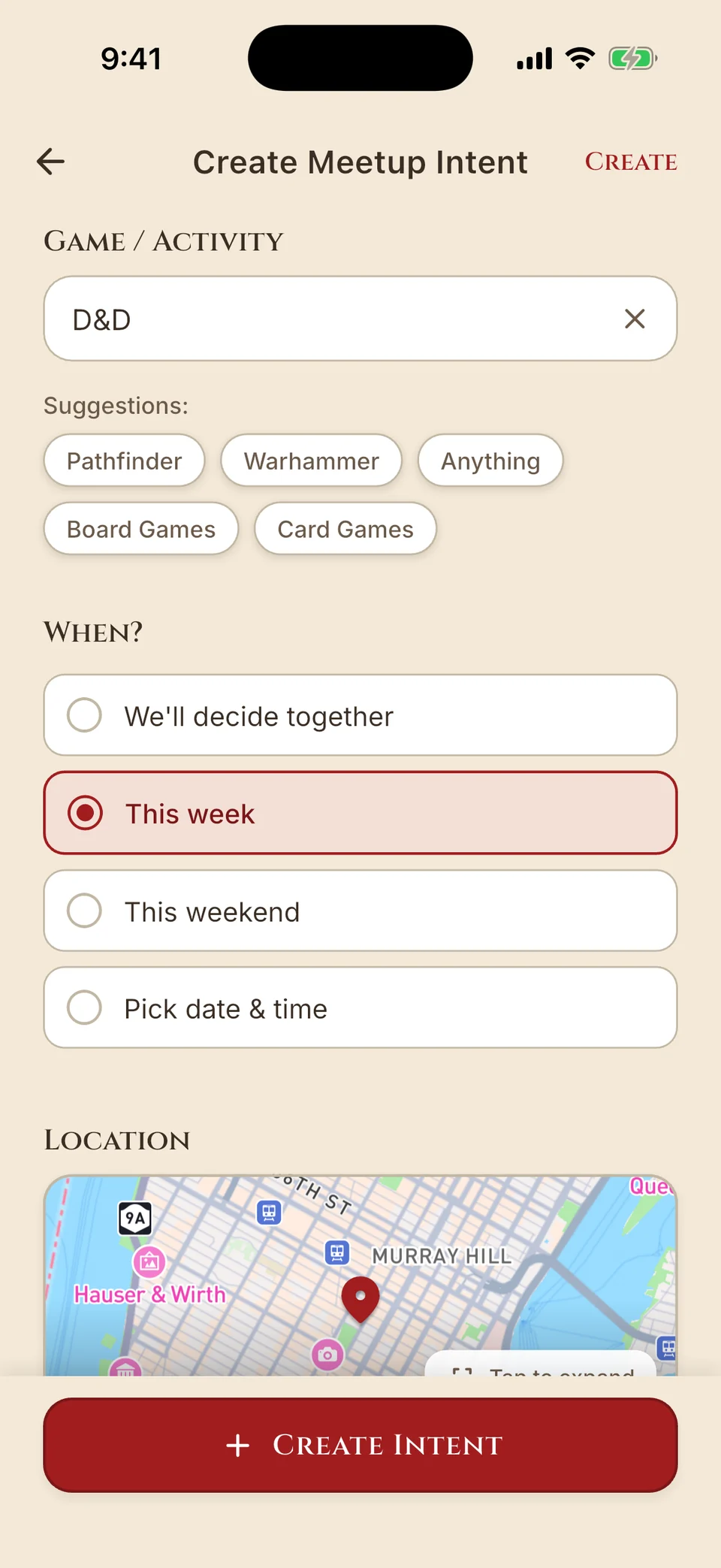
This is the part where we say what we built. DiceGather is an app for exactly this gap: you post a short meetup intent — the game, a rough time, a map pin, and a note — and people nearby who want the same thing can join and start talking. There is no application step and no "prove you're experienced" gate. Here's how meetup intents work. A beginner-friendly one-shot is exactly the kind of thing people post. For the wider comparison, we wrote about the apps people use to find players.
What to write when you reach out
Whether it's a Discord message, a store email, or an intent on a map, the same three sentences do the work:
- What you are. "Total beginner, never played, I've read the basic rules once."
- What you want. "Looking for a one-shot or a first session, not a long campaign yet."
- When you can play. "Free most Saturday afternoons and Wednesday evenings."
That's it. Don't apologize, don't write a paragraph about your childhood, don't promise to be a great role-player. A clear, short message from a beginner reads as reliable, and reliable is the thing tables are short of.
A version that works as a DiceGather intent note: "First-timer looking for a patient table. Happy with a pregen. Can bring snacks."
Ask for a one-shot, not a campaign
A one-shot is a self-contained adventure that starts and finishes in one session. For a beginner it is the right first ask for three reasons:
- Low commitment on both sides. If the table isn't for you, nobody has to have an awkward conversation about leaving.
- Pre-made characters are normal. You skip the hour of character creation and get straight to playing.
- The DM is already in teaching mode. One-shots are where DMs expect new faces.
If the one-shot goes well, ask whether the group is starting anything longer. That question, asked after a good session, gets a yes far more often than a cold "can I join your campaign".
Skip the parts that feel intimidating
You do not have to walk into a store on a Wednesday night, stand by a table of six strangers mid-combat, and ask if there's room. Some people are fine with that. If you aren't, there are gentler routes:
- Message first, show up second. Every option above has a way to say hello before you arrive.
- Bring one friend. Two beginners at a table is common and makes the first session easier.
- Let people come to you. Posting a specific "beginner-friendly D&D one-shot, Saturday afternoon, near downtown" and waiting for joiners flips the dynamic: the people who reply have already opted in to teaching.
On DiceGather, the map shows meetups, not people, so you're never being looked at. And when you're worried a quiet map means nobody plays in your town, the Nearby Players count tells you how many tabletop players are in your area without revealing where anyone lives.
What to bring and what to expect at session one
Bring a pencil, some paper, and a set of dice if you have one. If you don't, say so; someone will have a spare set. Eat beforehand and bring a drink. Sessions are usually three to four hours.
Expect the first fifteen minutes to be introductions and a short recap of how a turn works. Many DMs run a "session zero" or a short version of it: a conversation about tone, what everyone is hoping for, and any topics to avoid. Some tables use simple safety tools like the X-card, a card anyone can tap to skip a scene without explanation. None of this is a test. Say what you don't understand when you don't understand it.
The only unspoken rule worth knowing in advance: when it's your turn, decide reasonably quickly. "I attack the goblin" is a fine answer. Nobody needs a monologue.
Meeting strangers, briefly
The first session with people you met online belongs in a public place: the store, the library, a café with a back table. Tell someone where you're going. Get yourself there and back. That is the whole list, and it applies to any new group, not just this hobby. We wrote more about playing with strangers and enjoying it.
Roll the first die
Finding a D&D group as an adult beginner comes down to one honest message sent to the right place, and a one-shot on the calendar. Post yours, or join someone else's, and see who nearby is also looking for a table this week.
Yes, let's play.
DiceGather is free on iOS and Android. Post your first meetup intent in under a minute.


Frequently asked
Tags
Published by DiceGather Team on .
Yes, let's play.
DiceGather is free on iOS and Android. Post your first meetup intent in under a minute.
More from the journal
Browse all →
Is there an app to find people to play board games with?
Yes, several. An honest look at the apps and sites people use to find board game and D&D players nearby, what each is good at, and where DiceGather fits.
How to find board game players after moving to a new city
A two-week plan for finding board game players in a new city: where the scene hides, how to show up alone, and when to start hosting your own night.
Meetup.com alternatives for tabletop and board game groups
Looking for a Meetup.com alternative for board games or D&D? What Meetup still does well, where it falls down for small tables, and what to try instead.